
TVP Biomass Fermentation
Projects · Deliverables · Work with us · Team
Labs / Projects / TVP biomass fermentation
Texture
Cost & scalability
First results available
TVP biomass fermentation
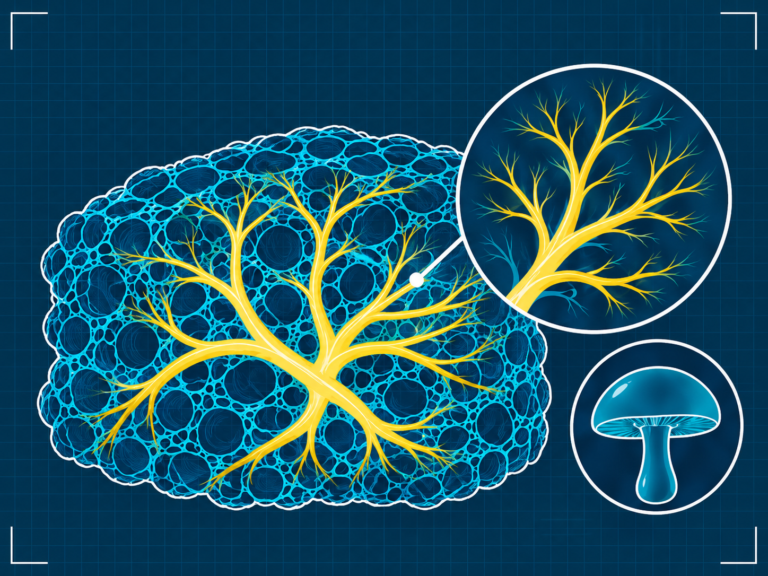
Growing fungus on a TVP scaffold, aiming for mycoprotein-class functionality at closer to TVP cost.
 Stage
Stage
Proof of concept complete · stage 2 starting
 Timeline
Stage 1 done in 2026 · stage 2 from Q4 2026
 Execution
Stage 1 with Solid Fermentation Innovation
 Open output
POC report · publication pending
The gap
Great texture, high cost
Fungal biomass brings a fibrous, layered texture that plant proteins struggle to match, but it is expensive to grow.
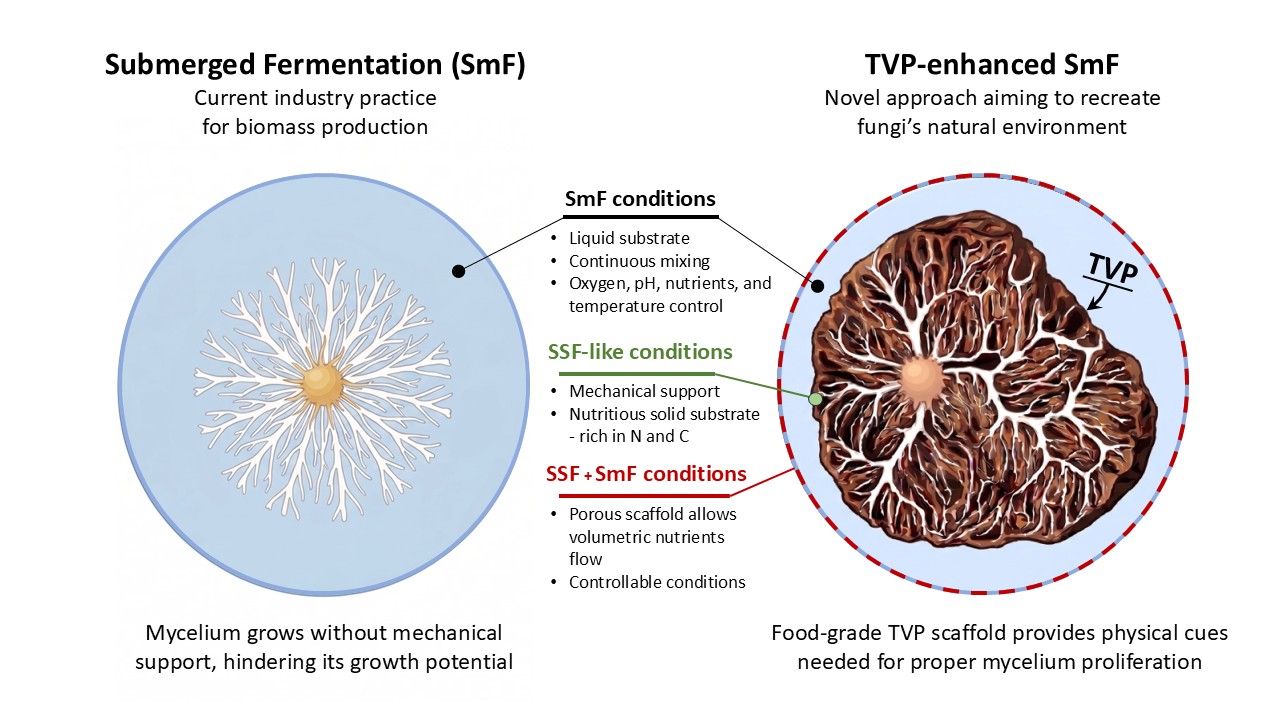
Submerged fermentation is controllable and scalable but gives the fungus nothing to grow into. Solid-state fermentation lets it colonize a structure, closer to how it grows in nature, but is harder to control and scale. TVP is the opposite: abundant, low-cost and food-grade, but limited by beany off-notes and texture.
$4–6 /kg
Modeled production cost of biomass-fermentation protein (GFI, 2025)
$2.70–3.66 /kg
Published wholesale prices for dry TVP (Green Circle Capital, 2024; ICI Foods list price, September 2026)
How it works
Give the fungus a scaffold to grow into
An intact TVP particle goes into the submerged fermenter, so the mycelium colonizes a structured, food-grade substrate while the process stays controllable.
Progress so far
Where the project stands
The project runs in stages. Each stage tests what the previous one left open, so every finding is reported with the stage that produced it.
 Done
Done
Proof of concept
Q1–Sep 2026
 Now
Now
Controlled reactor runs
From Q4 2026
Next
Larger batches for evaluation
Scope set by stage 2
Stage 1 · Proof of concept · completed September 2026
Does the fungus grow into a TVP scaffold?
We tested four ways of combining solid-state and submerged fermentation on intact TVP particles. Every run had a twin: TVP taken through exactly the same steps without fungus, so any difference could be traced to the fungus rather than to the process.
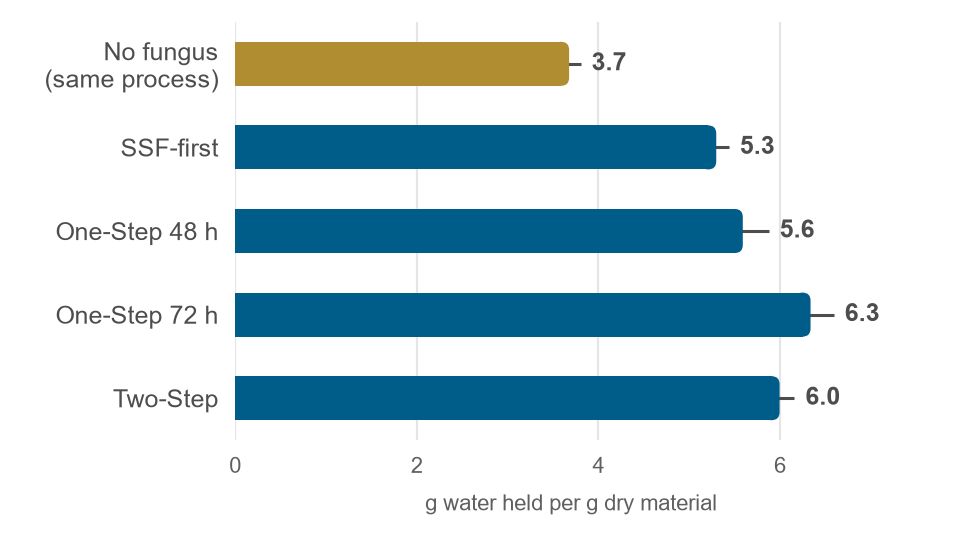
Fermented TVP holds more water
Only one route ended heavier than TVP on its own
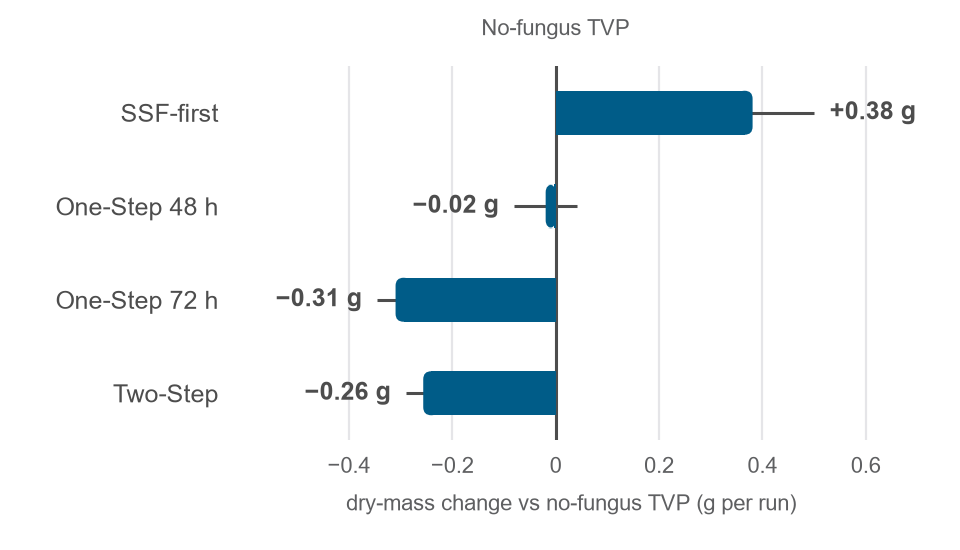
The two measures point in opposite directions: the route that kept the most mass held the least water. That is not what fungal growth alone would predict, and it is one of the questions this stage leaves open.
What it established
 A working end-to-end process. Fungus grown on intact TVP in a submerged vessel, then dried into an edible patty. We found no published report of this approach.
Higher water-holding. Every fermented route held more water than TVP processed the same way without fungus.
What it couldn’t show yet
 How much of the mass is new fungus. Nothing measured yet separates new mycelium from scaffold that simply survived. A fungal-specific assay would decide it.
Whether fermentation changes the taste. Five tasters tended to rate SSF-first higher on mushroom aroma and umami, but a panel this small can’t confirm a difference. No fermented sample differed from plain TVP on soy off-notes either, so that question is open, not answered.
Which route is best. SSF-first leads on mass, but it also received extra fresh medium, so its advantage can’t yet be attributed to the route itself.
Stage 2 · Now · agreement in progress
Can the process be controlled and repeated?
Stage 2 takes the process into small, controlled bioreactors with an experienced fermentation partner. It runs in three steps:
- Screen fungal strains on TVP, to pick the most promising combinations.
- Set the reactor’s operating conditions before any fungus goes in.
- Run the best condition more than once, to test whether the result can be reproduced.
As in stage 1, every comparison includes TVP processed without fungus, so changes can be traced to the fungus.
Stage 3 · Next
Is the material ready to be evaluated as food?
If stage 2 finds a condition that holds up and repeats, the next step is producing larger batches for evaluation, including a tasting panel once the material is cleared for food use.
Who’s involved
How the work is split
Labs by GFI Israel
Project lead
Project design, scientific direction, data analysis and the open-access report.
Technology partner · stage 1
Solid Fermentation Innovation (SFI)
Executed the proof-of-concept fermentations.
Fermentation partner · stage 2
Agreement in progress
An experienced fermentation partner will run the reactor work.

Last updated: October 2026
Related
More projects on texture
Texture
Fat & juiciness
Active
Mycelium performance
Validating mycelium as a functional ingredient for texture, juiciness, and cost efficiency.
Flavor & aroma
Texture
Emerging
Sensory-analytical correlation map
Building predictive models linking lab measurements with human sensory perception.
Labs by GFI Israel | A GFI Israel initiative | Complementary to GFI’s global alternative protein mission
[LinkedIn] · Contact: labs@gfi.org
