
Developing a plant-based beef-enhancer for blended products
Projects · Work with us · Team
Labs / Projects / Plant-based meat enhancer
Cost & scale
Tools & formulations
Completed
Full report available
Developing a plant-based beef-enhancer for blended products
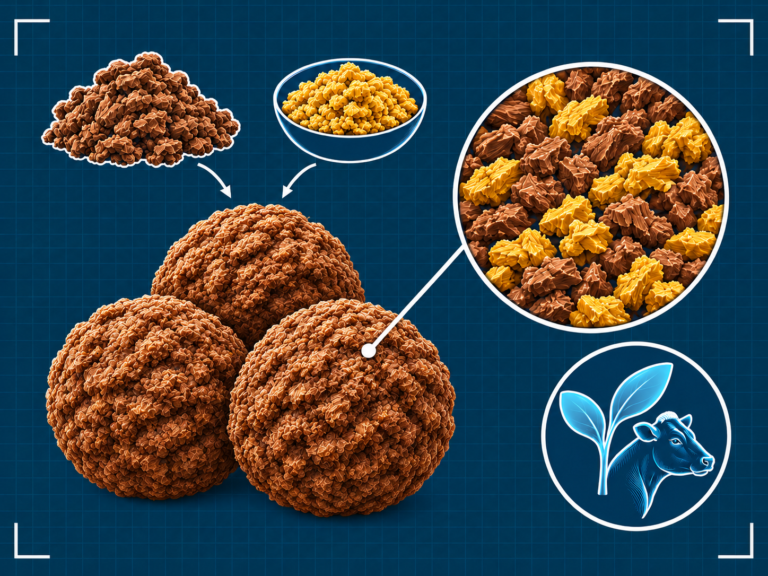
A six-ingredient plant base mixes straight into ground beef; 120 regular beef eaters chose a 50:50 blend almost as often as all-beef.
 Stage
Completed · both stages done
 Execution
Labs team · sensory laboratories
 Open output
Formula, protocols and data · open access
The gap
Blended beef: how much plant protein can it carry?
Blending plant protein into ground beef keeps a familiar dish on the plate with less meat in it.
The diner judges the blend against the all-beef version, so the plant portion works only when it is hard to notice. It also has to fit an existing kitchen process and carry an ingredient list a food-service buyer and a diner can read without hesitation.
51%
Of adults in ten European countries say they have reduced their meat intake, in a 2023 survey of more than 7,500 people (GFI Europe, 2023)
Who benefits
Who gains from an open blending base
The full formulation, the process and the panel data are published open access, for teams to test in their own products.
Meat processors
A tested base and blend ratios for ground-beef products with a larger plant share.
Food-service operators
A way to serve familiar beef dishes with less meat per portion, using the equipment a kitchen already has.
Plant protein ingredient suppliers
A short-label application for textured and functional plant proteins inside meat products.
How it works
Mix a six-ingredient base into ground beef
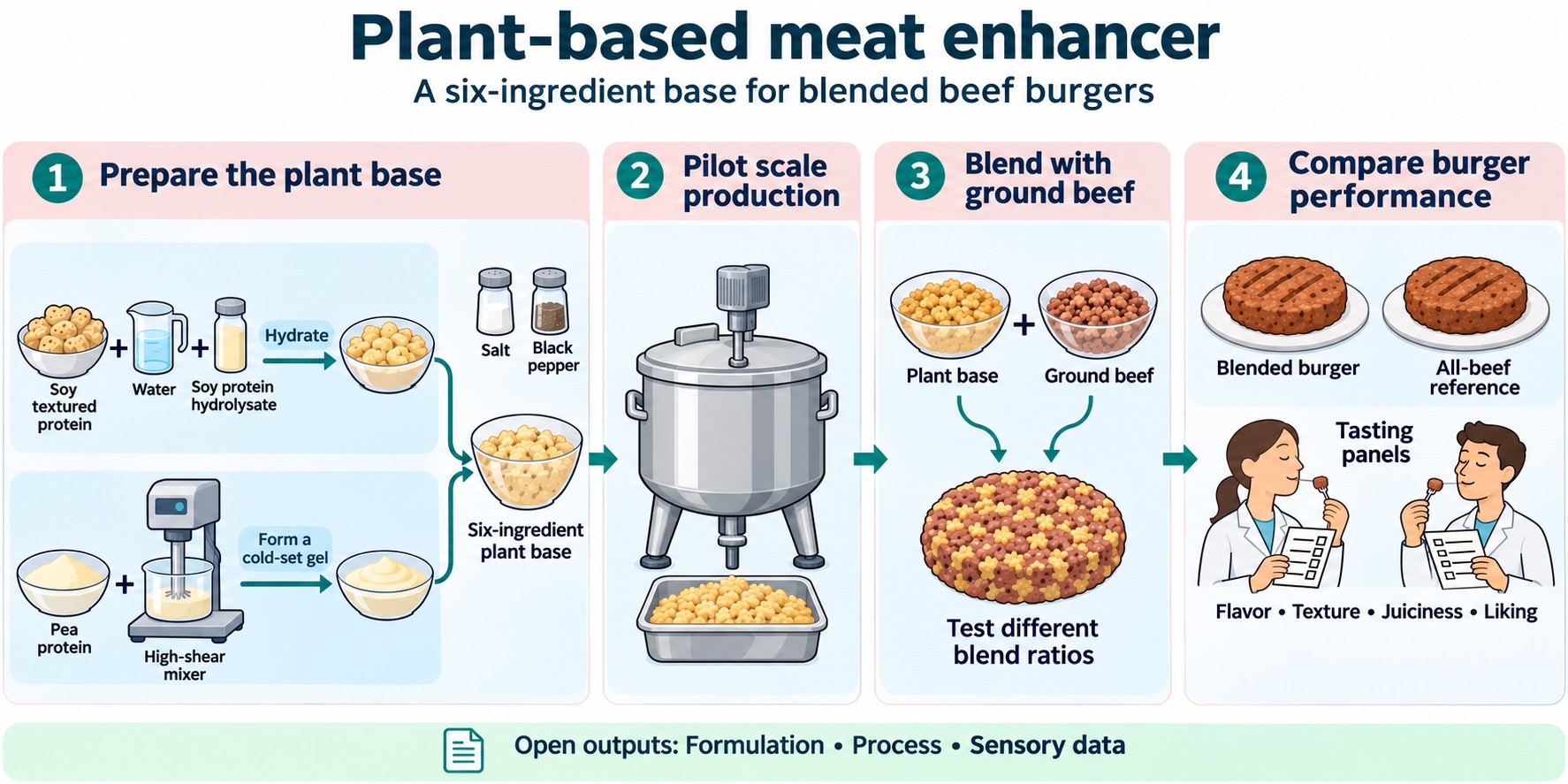
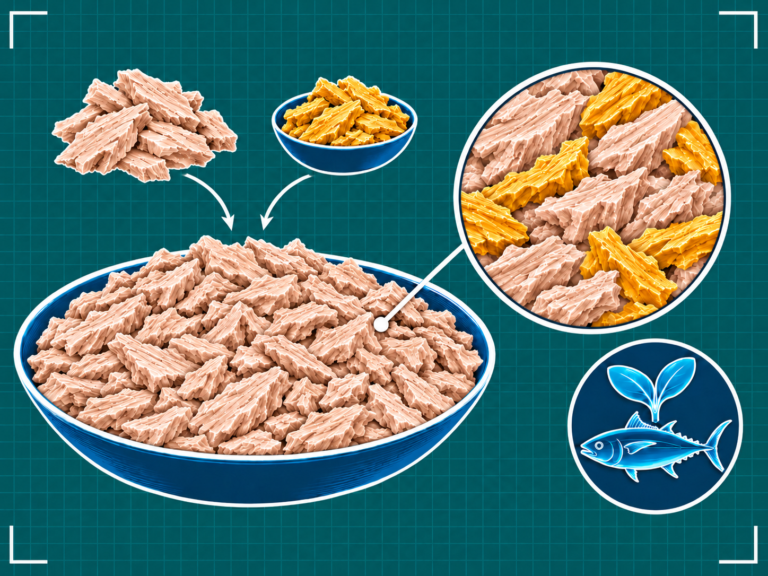
Soy texturized vegetable protein (TVP) is hydrated with a little soy protein hydrolysate and bound with a pea protein gel made cold under high shear; the base, seasoned with salt and black pepper, is then mixed into minced beef.
Progress so far
Where the project stands
The project runs in stages. Each stage tests what the previous one left open, so every finding is reported with the stage that produced it.
 Done
Stage 1 · Formulation and trained panel · completed
Can a six-ingredient base match the flavor of beef at 58%?
The base is made from water, soy TVP, pea protein, soy protein hydrolysate, salt and black pepper. A trained panel of 10 compared four versions of the formulation in plain burgers of 58% base and 42% beef, against 100% beef, on a 1–7 intensity scale, and then rated the four versions for liking.
Flavor matched beef; color and juiciness did not
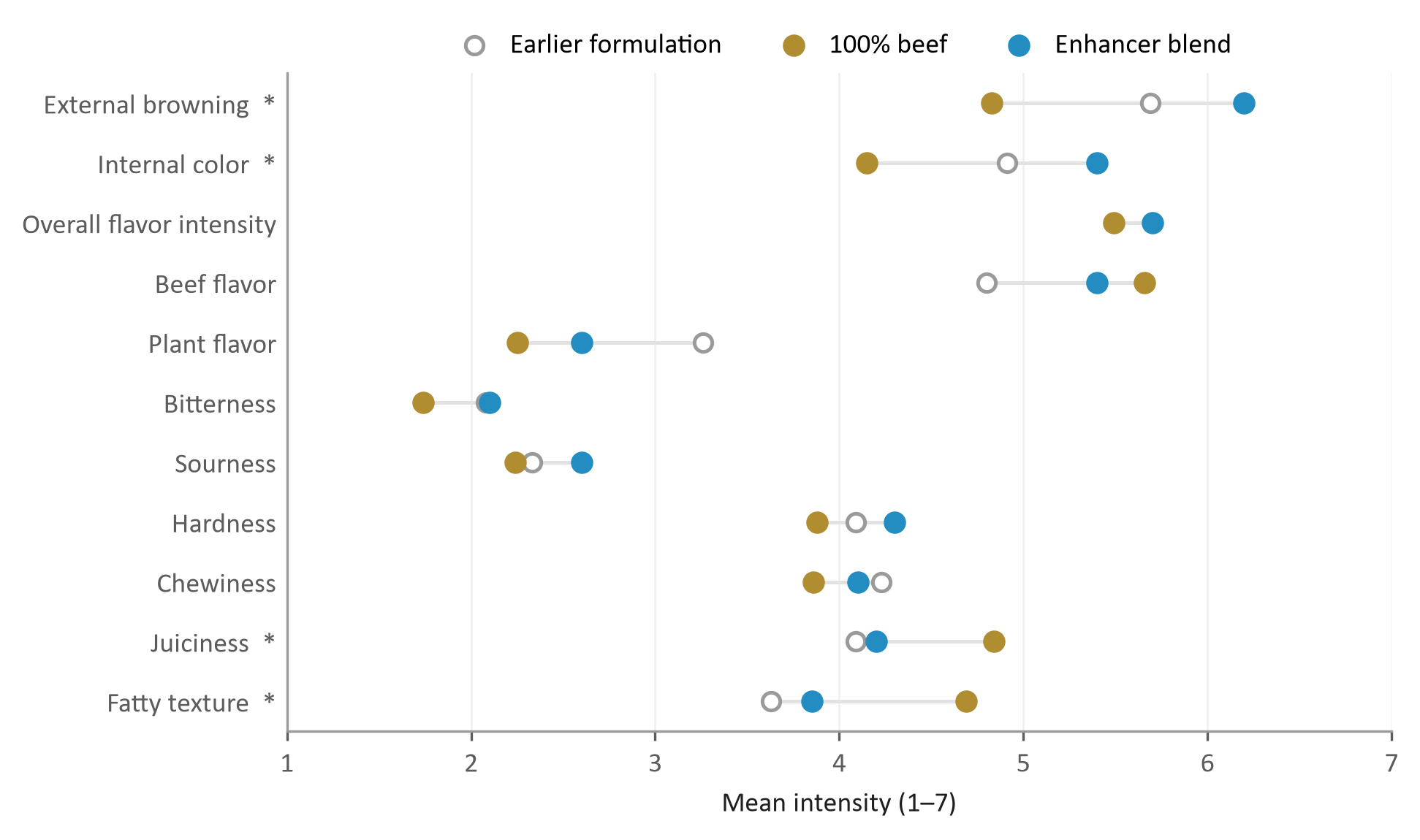
At 58% base, beef flavor, plant flavor and overall flavor intensity did not differ from 100% beef. The blend browned more on the outside, was darker inside, and scored lower on juiciness and fatty texture. The four versions did not differ on liking, so the version without flavoring or methylcellulose, with the shortest ingredient list, went forward.
What it established
 No flavor difference detected in a trained panel. Beef flavor, plant flavor and flavor intensity did not differ from 100% beef at 58% base.
A shorter label at no cost in liking. The six-ingredient version was liked as much as the versions with flavoring and binder.
What it couldn’t show yet
 Beef-like color and juiciness. The blend was darker, and less juicy and fatty than beef.
Stage 2 · Blend ratio and consumer test · completed
Do consumers choose a 50:50 blend as readily as beef?
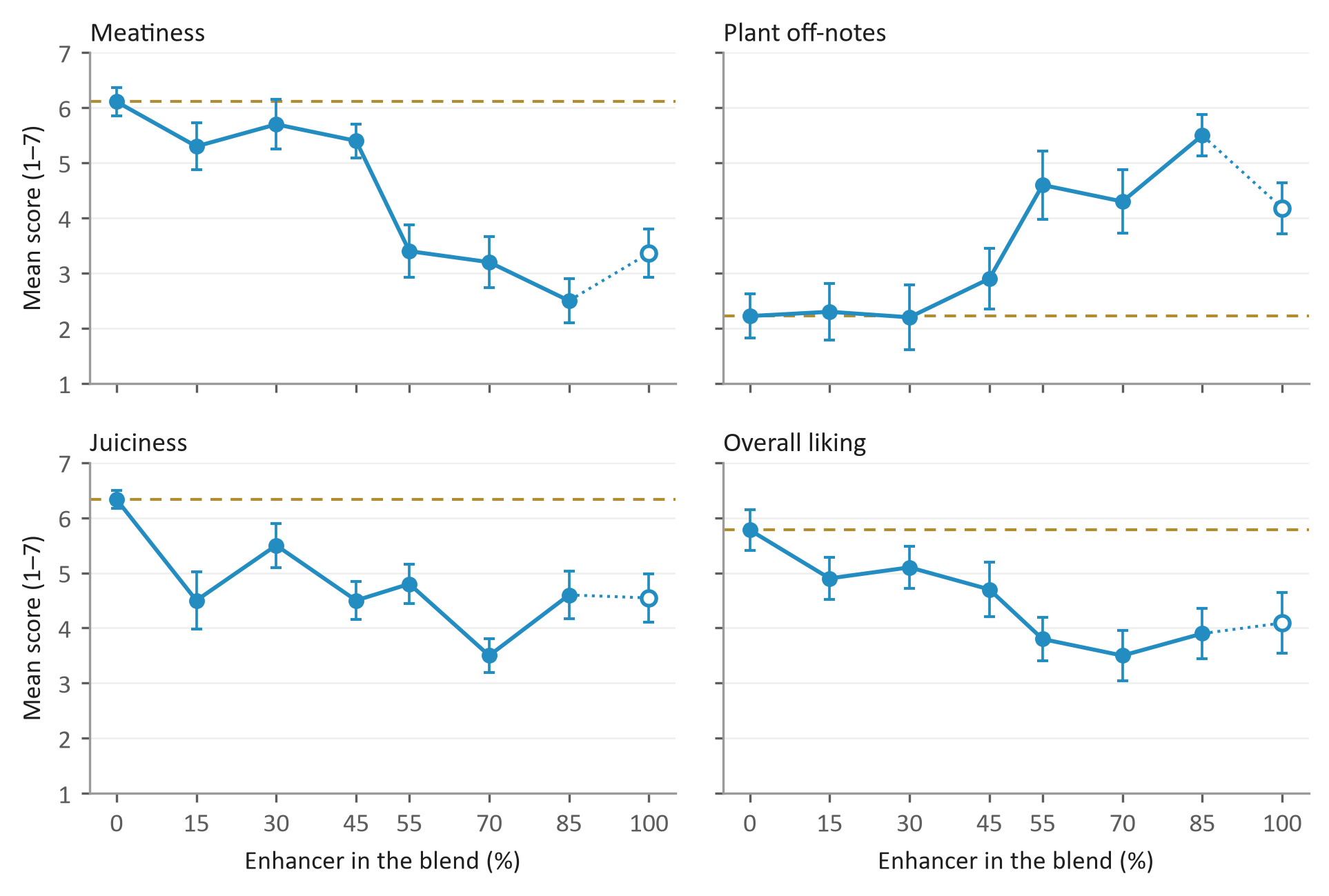
An internal panel of ten tasted eight blend ratios to see where meatiness starts to change. Then 120 regular beef eaters tasted a 50:50 blend and a 100% beef patty one at a time, rated each on 7-point scales, and chose between them.
Meatiness matches beef up to 45% enhancer, then drops
Consumers split almost evenly between blend and beef
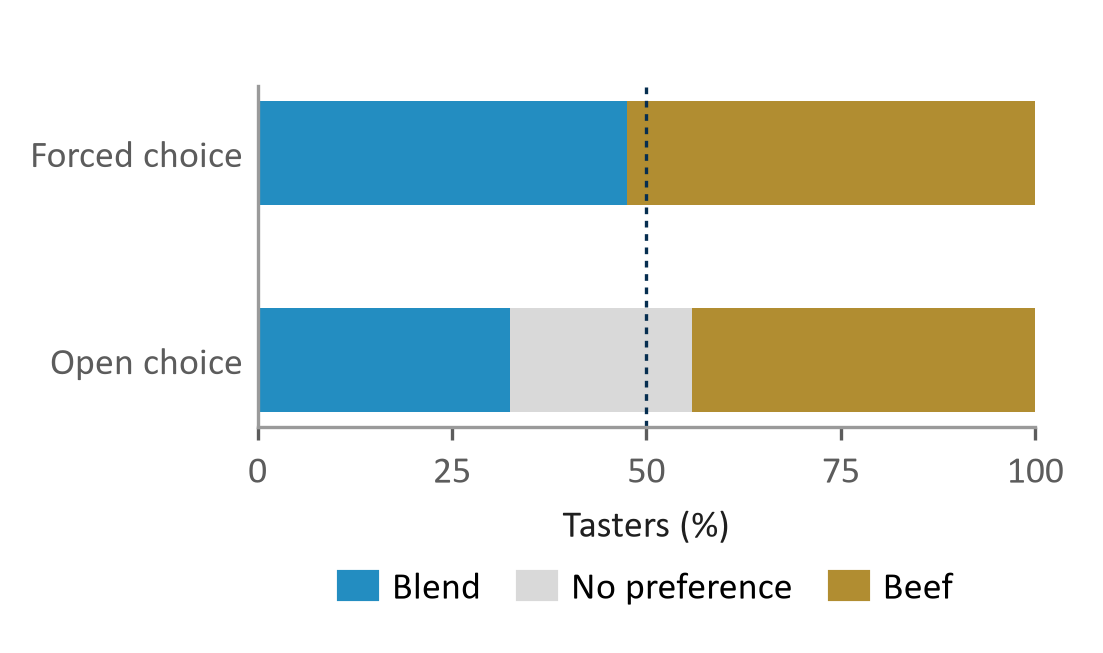
In the internal screen, which scored meatiness rather than the trained panel’s flavor attributes, meatiness matched beef at 15%, 30% and 45% base and was significantly lower from 55%. Forced to choose, 57 tasters picked the blend and 63 beef, a split that does not differ from even. The blend was liked slightly less overall after the first bites, by 0.42 points on the 7-point scale; appearance, aroma and texture did not differ, and purchase intent was similar (54% vs. 59%).
What it established
An even choice. Consumers forced to choose split almost evenly between the 50:50 blend and beef.
A range for the ratio. In the internal screen, meatiness matched beef up to 45% base and was significantly lower from 55%.
What it couldn’t show yet
Liking equal to beef. The blend scored slightly lower overall, with juiciness, oiliness and hardness named as the main shortfalls. The internal screen also found juiciness below beef at most ratios.
Who’s involved
How the work is split
Labs by GFI Israel

Project lead, experimental executor
Formulation and process development, in-house experimental work, the internal blend-ratio screen and the open-access report.
Sensory evaluation

New Sense Research
Ran the trained descriptive panel and the consumer test with 120 regular beef eaters.

Talk to the project lead
Anton Slavkin
Associate Director of Food Engineering and Projects Lead · labs@gfi.org
Last updated: November 2026
Related
More projects on Cost & scale

Labs by GFI Israel | A GFI Israel initiative | Complementary to GFI’s global alternative protein work
Contact: labs@gfi.org
