
Tackling the juiciness challenge with a low-cost bench test
Projects · Work with us · Team
Labs / Projects / Juiciness measurement & improvement
Tools & formulations
Sensory performance
Active
First results available
Tackling the juiciness challenge with a low-cost bench test
A simple press measures the liquid a plant-based sample releases under load, aiming for a scale that ranks juiciness as tasters do.
 Stage
Beef press study done · in-house calibration underway
 Timeline
External execution · done
In-house press calibration · ongoing
 Execution
Press study with Milouda Laboratories Mérieux · rest in-house
 Open output
Press-method report and code · published open access
The gap
Juiciness is the greatest sensory gap in texture with no standard measurement for plant-based meat
Juiciness is the top texture gap blind tasters find in plant-based meat, yet the only direct way to measure it is a tasting panel.
A large, external panel can’t be run on every recipe change, so juiciness decisions often rest on informal tasting, which doesn’t scale or transfer between labs. The instruments that come closest, such as texture analyzers, are expensive and measure how hard a sample resists deformation, whereas juiciness depends on how much liquid it releases. Developers need a cheap bench number they can trust to follow what tasters perceive.
#11 of 122
Increasing juiciness, the top of the 12 texture attributes tasters could check, across 14 plant-based meat categories (1NECTAR, Taste of the Industry 2025; 2van den Bedem, Kuhl & Cotto, 2026)
22% vs 38%
Blind tasters who called the burger juicy: average plant-based burger vs. a beef burger (NECTAR, Taste of the Industry 2025, burgers dashboard)
Juiciness is one of the most difficult attributes of meat and plant-based meat to replicate or measure accurately (Rudge et al., 2025, Food Hydrocolloids)
Who benefits
Who gains if juiciness can be measured cheaply
Every protocol and result is published open access, so any company or lab can run the test.
Plant-based meat developers
A bench scale indicating juiciness changes they can check on every recipe change, before paying for a tasting panel.
Texturized vegetable protein, binder, and fat suppliers
A shared, low-cost way to demonstrate ingredients’ impact on juiciness in a finished patty.
Contract testing labs
A documented protocol they could offer as a juiciness screen alongside tasting panels.
Researchers
The full protocol, data, and analysis code, to repeat the test and check it against their own panels.
How it works
Press the sample, weigh the liquid it releases
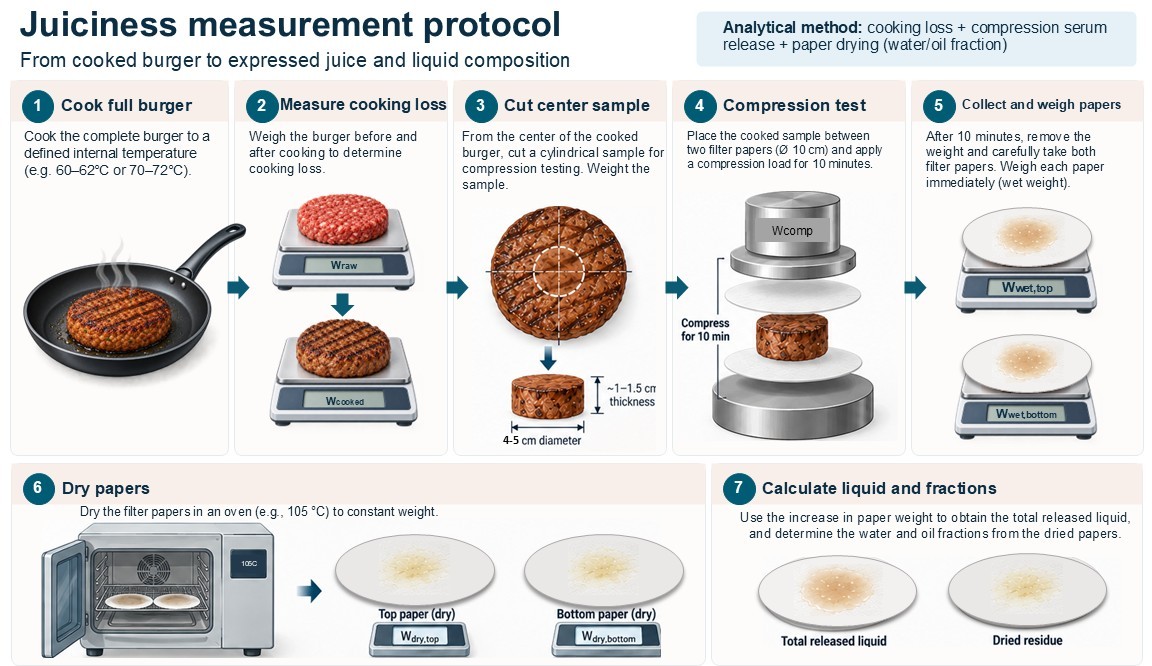
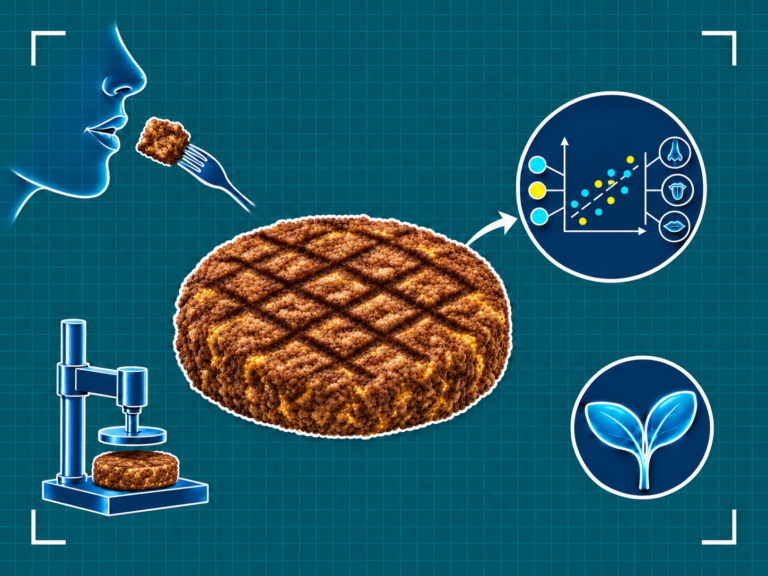
A disc of cooked patty or hydrated texturized vegetable protein (TVP) is pressed between paper under a set load; the liquid absorbed by the paper, weighed on a balance, is the reading.
Progress so far
Where the project stands
The project runs in stages. Each stage tests what the previous one left open, so every finding is reported with the stage that produced it.
 Done
Initial beef burger press study
Feb–Oct 2026
 Now
In-house press tool calibration on plant-based ingredients
From Sep 2026
 Next
Studying ingredients’ impact on juiciness
Scope set by stage 2
Stage 1 · Initial beef burger press study · completed October 2026
Can a simple press detect a known juiciness difference?
With our execution partner, we cooked the same commercial beef burger to 60–62 °C and 70–72 °C (medium and well-done), pressed discs cut from each under a fixed load, and weighed the liquid absorbed by the filter papers. Each run cooked both endpoints from one lot on the same day, so every run is a self-contained comparison.
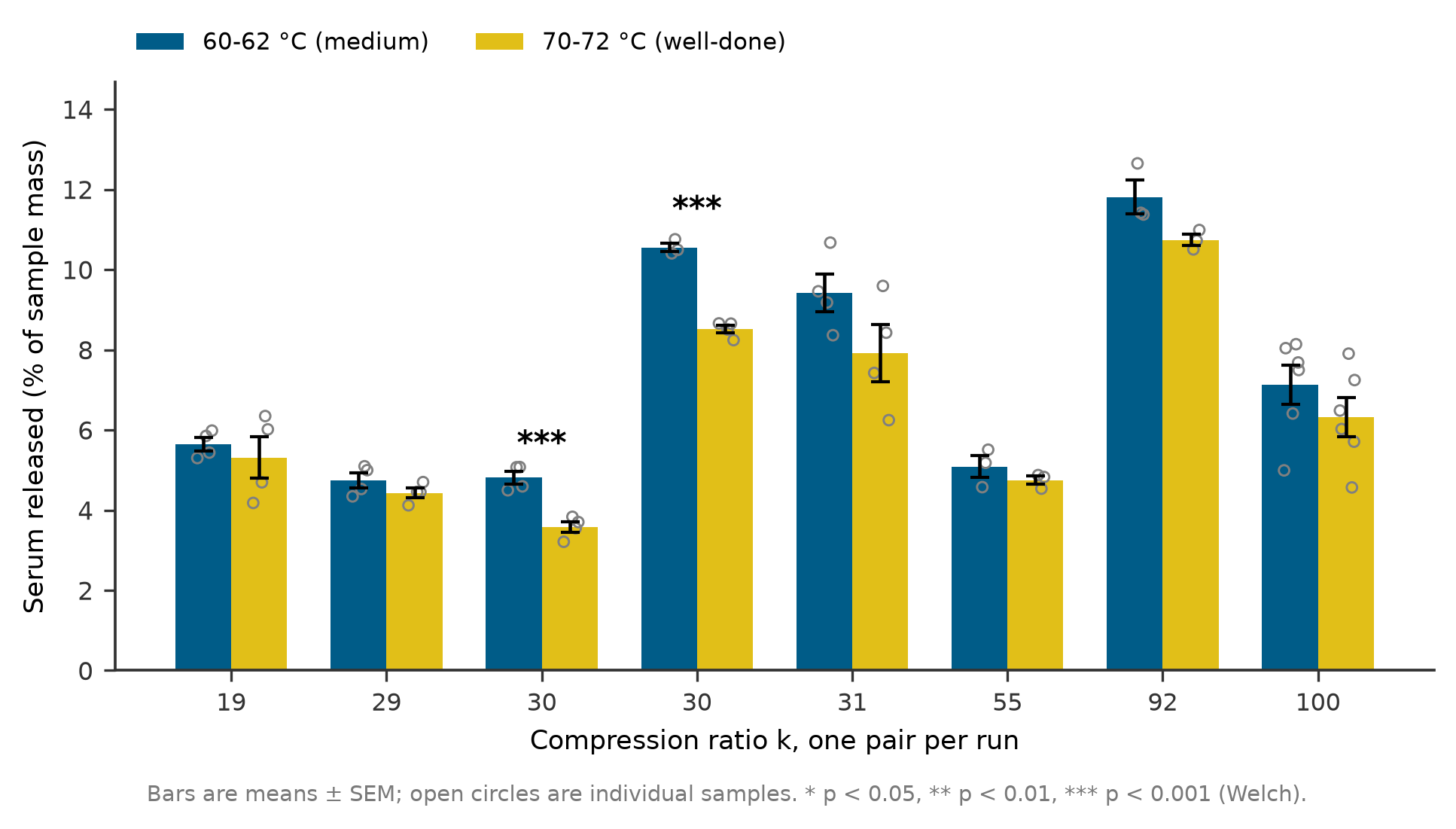
Medium patties released more liquid in every run
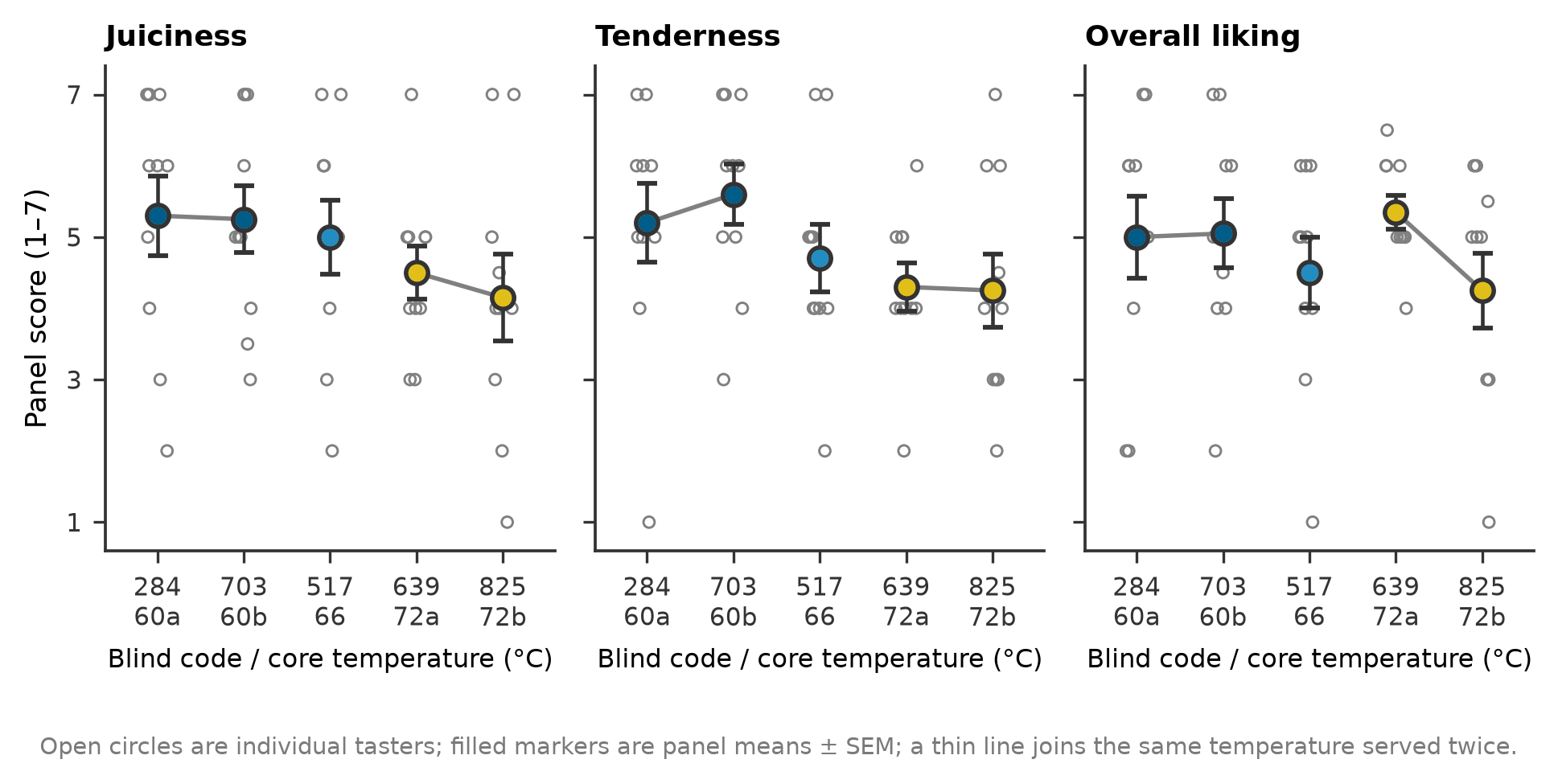
Tasters scored the medium burgers juicier and more tender
The press reads a real difference: on average, medium patties released 0.95 points more liquid, as a share of sample mass, and the reading didn’t simply track cooking loss. But repeating a run at the same settings moved the number more than the cooking did, so it can’t yet compare samples run on different days.
What it established
 A complete, low-cost measuring route. A balance, a cookie cutter, filter paper and a weight take a cooked patty to a number, with the protocol written down.
The right direction in every run. Medium patties released more liquid than well-done ones in every run, and some runs separated them on their own.
Tasters perceive the same contrast. Blind tasters rated beef burgers cooked to 60 °C as juicier and more tender than those cooked to 72 °C.
What it couldn’t show yet
 Whether it repeats between sessions. Identical settings gave readings up to about twofold apart, and each run used a new burger lot, so the press and the burger can’t be told apart yet. Testing one lot across days, and several lots on one day, would decide it.
Whether it works on plant-based meat. Only beef was tested, and plant-based patties behave differently under load. Testing them at their own settings would settle it; stage 2 starts there.
Stage 2 · Now
Does the press rank plant-based samples the way tasters do?
Stage 2 moves the press to plant-based materials in our own lab, working out its settings from what stage 1 found. On hydrated TVP it already separates wet from dry samples clearly, and similar TVPs are the next test. Then it runs in three steps:
- Find the load that best separates two plant-based samples, for hydrated TVP and cooked plant-based burgers.
- Check whether the reading ranks plant-based burgers the way tasting panels already scored them.
- Test whether one load works for both, or each needs its own.
Every pair of samples is pressed on two days at the same settings, and a difference counts only if it is at least twice the scatter and points the same way on both days.
Stage 3 · Next
Can the press find changes that make plant-based patties juicier?
If stage 2 finds a setting that ranks burgers the way tasters do, the next step is to use it to screen formulation and process changes in plant-based patties, then confirm the best ones with a tasting panel.
Who’s involved
How the work is split
Labs by GFI Israel

Project lead, experimental executor
Project design, in-house experimental work, data analysis, and the open-access report.
Execution partner · stage 1

Milouda Laboratories Mérieux
Drafted the press protocol with us and ran every beef burger experiment.
Tasting panel organization

New Sense Research
Recruited the tasters and scheduled the blind tasting panels.

Last updated: November 2026
Related
More projects on Tools & formulations
Labs by GFI Israel | A GFI Israel initiative | Complementary to GFI’s global alternative protein work
Contact: labs@gfi.org
